
PerspectivesEssay
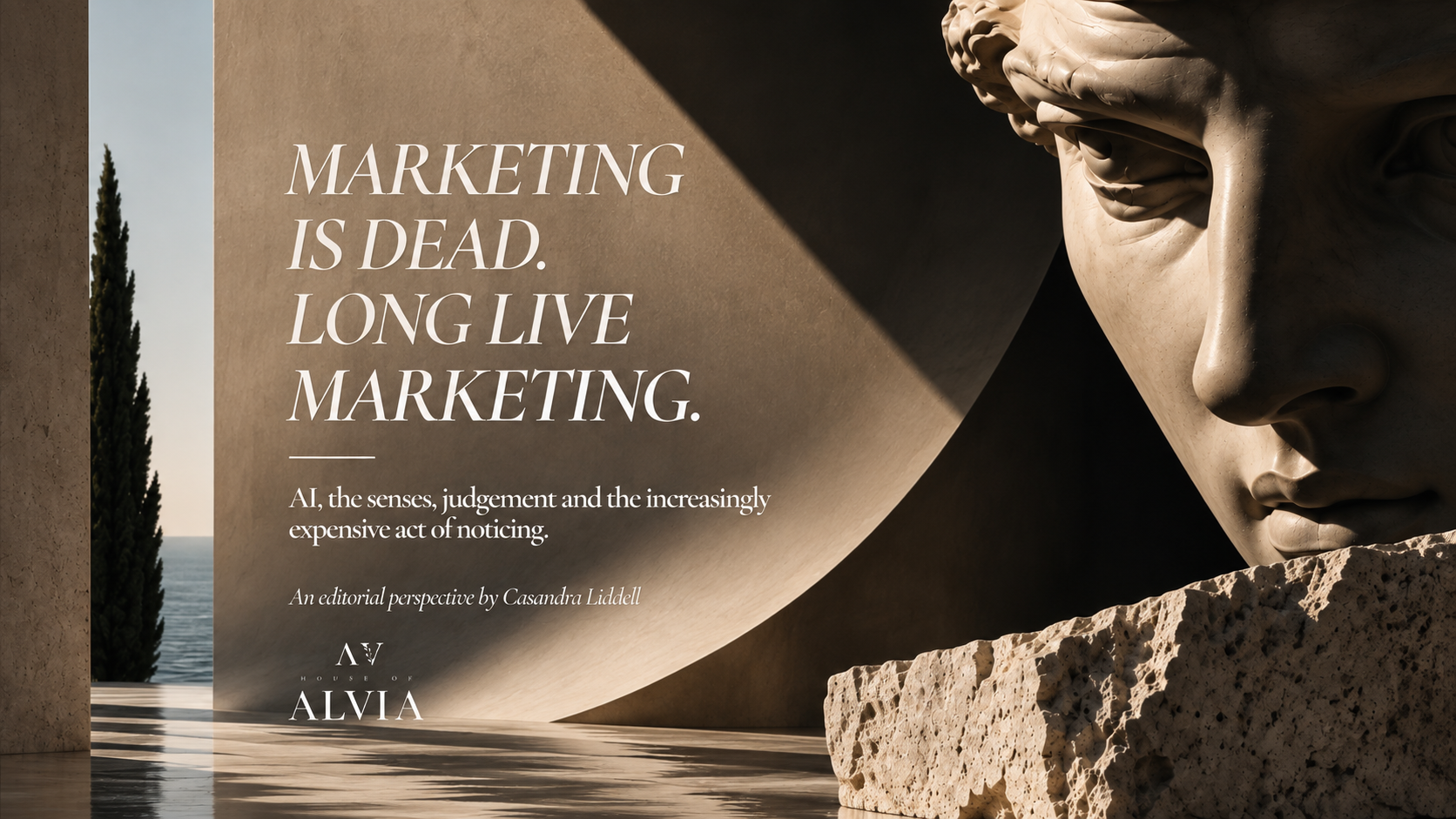
Marketing Is Dead. Long Live Marketing.
AI, the senses, judgement and the increasingly expensive act of noticing.
Casandra LiddellFounder, House of ALVIALondon
Competence is becoming abundant
AI is not making marketing irrelevant. It is making competent production easier to obtain. More copy. More images. More variations. More polished output, produced faster and at lower cost.
Ahrefs' 2025 survey of 879 marketers found that 87% were already using AI to help create content. AI users reported publishing a median of 17 articles a month, compared with 12 among non-users, roughly 42% more output. The same research estimated an AI-generated blog post at about $131 versus $611 for a human-written post, based on respondents' cost ranges.
Source: Ahrefs, State of AI in Content Marketing / AI content cost research, 2025. Survey: 879 marketers.
When the machinery becomes abundant, judgement becomes the luxury.
This is the part of the AI conversation I find more interesting than whether a machine can write a headline. If production becomes abundant, value does not disappear. It moves upstream, toward judgement, taste, editing, context, originality, timing and meaning.
AI raises the floor. Judgement determines the ceiling.
The senses may be a useful place to look
Marketing has spent years turning people into audiences, segments, impressions and conversion paths. But people still encounter the world through a body before they encounter it through a dashboard.
The senses are not five new channels to optimise. They are a reminder that experience is received as a whole. A room, a product, a voice, a material, a gesture and a memory can say more together than another perfectly formatted piece of content.
Visual
When everything is designed to be seen, what do we still notice?
We have become extraordinarily good at producing things to look at. AI accelerates an appetite that was already there: another image, another campaign, another immaculate feed, another variation of an idea that performed rather well last Tuesday.
The paradox is simple: visual abundance does not guarantee visual memory. When every surface asks for attention, restraint can become a form of emphasis. Social media may become so full that emptiness itself becomes a competitive advantage.
Sound
There is a difference between being heard and being remembered.
Brands have spent decades perfecting how they look and considerably less time considering how they sound. A voice, a piece of music, the acoustics of a room, or occasionally the confidence to leave it quiet, can alter the way an experience is felt.
Scent
The sense that arrives before language.
Scent is interesting precisely because it resists the neatness of a marketing framework. We rarely enter a room and intellectualise the olfactory cue. We simply register something. Sometimes, years later, we remember it.
The point is not to turn scent into another tactic. It is to notice how much of memory and atmosphere sits outside explicit messaging.
Touch
The internet removed friction. Perhaps it removed something else with it.
There is a reason opening a beautiful box can feel disproportionately satisfying: the weight, the resistance, the paper, the tiny pause before the object appears. Efficiency might call some of these things unnecessary. Experience may disagree.
Taste
Taste is also knowing what not to add.
Taste is literal, of course. Hospitality understands this beautifully. But it is also the word we use when someone knows what to omit. That second meaning becomes considerably more interesting in the age of AI.
Taste is also knowing what not to add.
AI can give us 1,000 possibilities. Taste is knowing which 999 to leave behind.
The senses were never meant to work in departments
We do not experience a hotel as a visual identity followed by an olfactory strategy followed by a customer-service touchpoint. We experience a place. The light, the voice at reception, the weight of the key, the temperature of the room, the scent in the corridor, the music we barely registered and the person who remembered something we mentioned yesterday become one memory.
The senses were never meant to work in departments.
This is where luxury is useful as a test case. McKinsey's 2026 luxury research, based on more than 2,000 clients in the US and China, describes emotional connection as increasingly important, experiences competing with products for discretionary spend, and recognition and personal attention as important elements of high-touch service.
Source: McKinsey & Company, State of luxury: US and China outlook, June 2026; survey of 2,000+ luxury clients in the US and China.
Luxury is consideration made perceptible.
Knowing is not the same as noticing
AI can recognise the pattern. Judgement notices the hesitation, the room, the wrong question and the thing nobody put in the brief.
That distinction matters because personalisation is not the same as recognition. Knowing what somebody clicked is useful. Noticing what would make them feel understood is something else.
The extraordinary experience is rarely remembered because every procedure was executed correctly. It is remembered because someone noticed something.
Partnership is not distribution
The same applies to partnerships. A partnership should change the idea. It should introduce a different audience, intelligence, culture, permission or point of view. If nothing changes except the logo, the guest list and the media plan, it may simply be media buying wearing a very nice jacket.
Edelman's 2025 creator research reported that 60% of consumers trust what a creator says about a brand more than what the brand says about itself. The more useful implication is not "use more creators." It is to treat collaborators as strategic inputs and co-creators rather than distribution channels.
Source: Edelman, creator partnerships research, 2025.
Context is a medium too
Moving to London has made this increasingly visible to me. Fashion beside finance. Hospitality beside culture. Old institutions beside new ideas. The city is a reminder that meaning is often produced by proximity: who is in the room, what histories are present, what references are understood without explanation.
Sometimes the most valuable thing in the room is not the message. It is the room.
Less broadcasting. More belonging.
And then there is thought
AI can give us more answers. The interesting question is what happens to our questions.
I like poetry. Does my audience? Perhaps that is the wrong question. Poetry is compression. A good metaphor can make a complicated truth felt before it is fully explained. Sometimes the metaphor is the strategy.
This is not an argument for making marketing less commercial. It is an argument for making it less interchangeable. Critical thinking, curiosity, editing, perseverance, cultural instinct and the ability to connect things that were not previously connected become more valuable when competent execution is easy to summon.
What, then, is dying?
Perhaps not marketing. Perhaps only the comfortable parts of it: the volume, the formula, the interchangeable content, the confusion of visibility with relevance.
The original work remains: understanding people, culture, desire and context; deciding what deserves to exist; creating relationships; and making something matter.
Make meaning before making content.
Marketing is dead. Long live marketing.
Make meaning before making content.
Casandra LiddellHouse of ALVIALondon