
AI · GEO & SEO · Brand · Technology
The Internet Knows You. But Will AI Recommend You?
From SEO to GEO: how artificial intelligence is rewriting the rules of brand visibility, reputation and influence.
Search used to ask a relatively simple question: can people find you? Generative search asks something more demanding: when an AI system assembles an answer, does it understand you well enough to include you, and trust you enough to cite you?
From ranking to retrieval
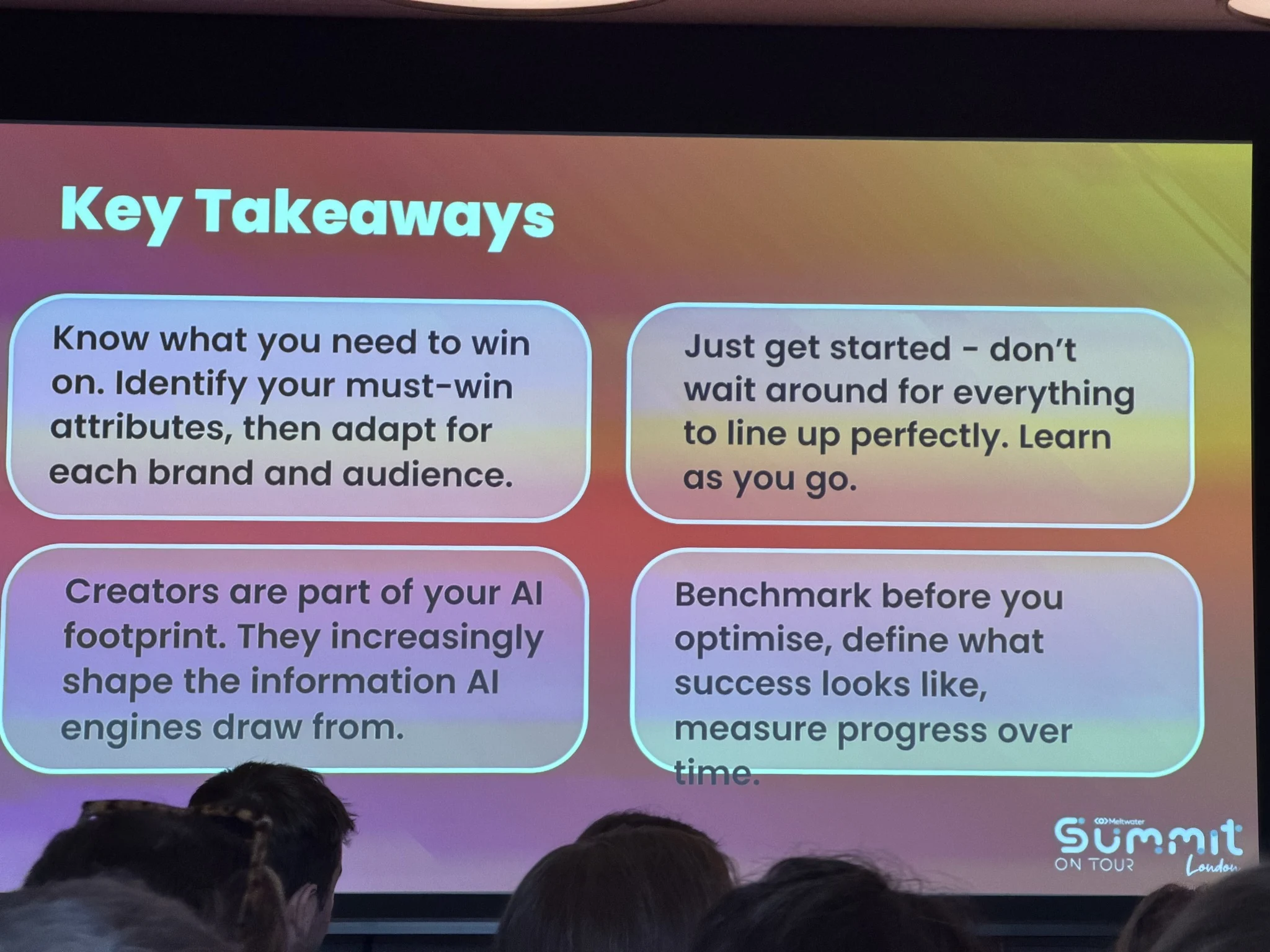
At Meltwater Summit on Tour in London, one idea kept returning in different forms: visibility is no longer only a question of where a brand ranks. It is increasingly a question of whether a brand becomes part of the answer.
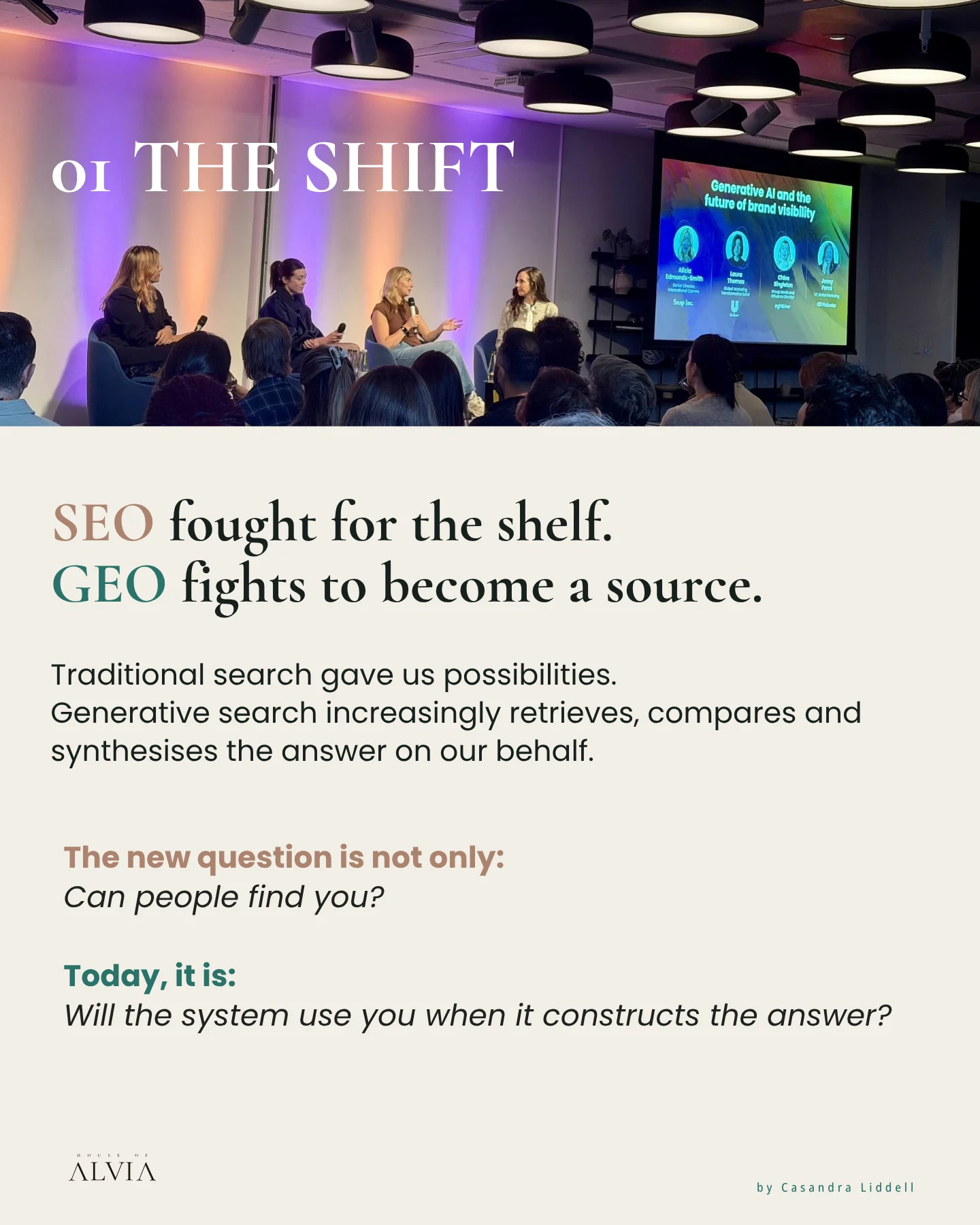
That distinction matters. Traditional search gave us a page of possibilities. Generative search increasingly gives us a synthesis. The user may never inspect ten blue links; an AI system retrieves, compares, compresses and presents a response on their behalf.
The simplest metaphor is this: SEO was partly about earning a good place on the library shelf. GEO is about becoming one of the books the librarian reaches for when someone asks a question.
That changes the job. A beautiful website is not enough. A large volume of content is not enough. Even ranking is not enough. A brand has to be findable, understandable, corroborated and useful at the precise moment an answer is being assembled.
GEO, AEO and SEO: different names for an overlapping problem
GEO, Generative Engine Optimisation, is the emerging practice of improving the probability that content is retrieved, used, cited or accurately represented in generative answers. AEO, Answer Engine Optimisation, is the broader idea of structuring information so that answer systems can resolve a question directly.
The terminology is still unsettled. Google explicitly argues that its existing SEO fundamentals remain the foundation for visibility in AI Overviews and AI Mode; there is no special “AI schema” or secret markup that guarantees inclusion. Microsoft, meanwhile, now uses GEO language in its own webmaster tooling and reports citations, grounding queries and citation share.
So I would resist treating GEO as a replacement for SEO. It is better understood as an additional layer of visibility.
SEO asks: can the system discover and rank this page?
AEO asks: can the system extract a clear answer from it?
GEO asks: will the system retrieve, trust, use and represent it when constructing an answer?
The three overlap. The difference is that the unit of competition is moving from the page to the passage, the entity, the fact and the source relationship.
The four questions every brand should now ask
One of the most useful frameworks at the Summit was the “4 Ps of AI Visibility”: Presence, Prominence, Portrayal and Persuasion.
Presence: Do we appear at all? Are our pages or third-party sources about us being cited?
Prominence: When we appear, how visible are we relative to competitors and other sources?
Portrayal: What does the answer actually say about us? Are our defining attributes present, accurate and current?
Persuasion: Does that visibility influence action: a visit, enquiry, shortlist, booking, purchase or recommendation?
This is a more sophisticated way to think about AI visibility than counting mentions. A brand can have presence and still be poorly portrayed. It can be accurately portrayed but absent from the category questions that matter commercially. It can earn citations without earning preference.
Citation is not the same as endorsement. Visibility is not the same as meaning.
How generative search actually finds an answer
The mechanics vary by platform, but the underlying logic is increasingly familiar. A system interprets the question, may expand it into several related searches, retrieves candidate sources, evaluates passages, supplies selected material to a model and synthesises a response.
Google describes AI Mode and AI Overviews as using retrieval-augmented generation and “query fan-out”: one complex question can trigger multiple related searches across subtopics. Microsoft describes the retrieved evidence used by an AI answer as grounding. OpenAI says public sites can appear in ChatGPT search and recommends allowing OAI-SearchBot if publishers want content to be discovered, surfaced and cited. Claude and Perplexity also use web retrieval with citations when search is active.
The implication is important: we are not optimising a single answer. We are improving the quality of the evidence from which many possible answers can be assembled.
Think less like writing one perfect brochure and more like preparing a well-run press room. The facts must be clear. The names must be consistent. The evidence must be easy to locate. The useful quote must not be buried on page 47.
One source of truth, many retrieval contexts
The temptation is to create “ChatGPT content”, “Gemini content”, “Perplexity content” and “Claude content”. I think that is the wrong direction.
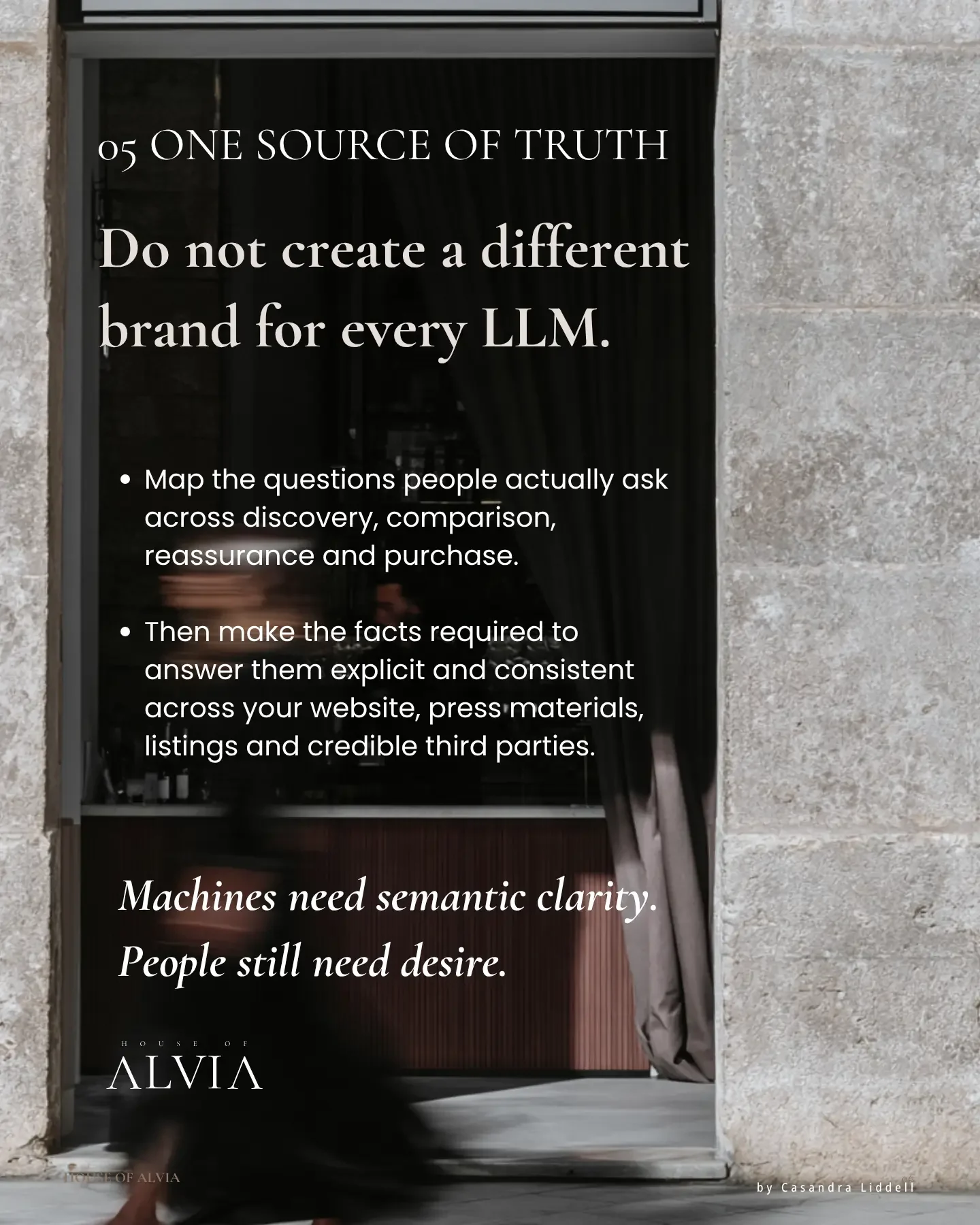
The stronger strategy is one coherent source of truth expressed in forms that different retrieval systems can understand.
Start with the questions people actually ask, not only the keywords they type. Map high-value prompts across the customer journey: discovery, comparison, reassurance, specification, reputation, purchase and post-purchase. Then identify the facts and proof required to answer each one.
A luxury hotel, for example, should not only publish “our story”. It should make its distinctive attributes explicit: location, architecture, room count, signature experiences, service philosophy, dining concepts, accessibility, family policy, opening dates, awards, sustainability evidence and the details that genuinely differentiate it. Those facts should be consistent across the website, press materials, profiles, listings and credible third-party coverage.
Machines need semantic clarity. People need desire. The craft is doing both without making the brand sound as if it was written for a machine.
What the evidence suggests helps
The original academic GEO paper found that certain interventions, including adding credible citations, quotations and statistics, could improve visibility within its experimental generative-engine setting. But later research has added an important caution: results are highly conditional, platforms vary, and a tactic that improves citation after content has already been retrieved does not necessarily improve organic discoverability.
That is why I would prioritise fundamentals over hacks.
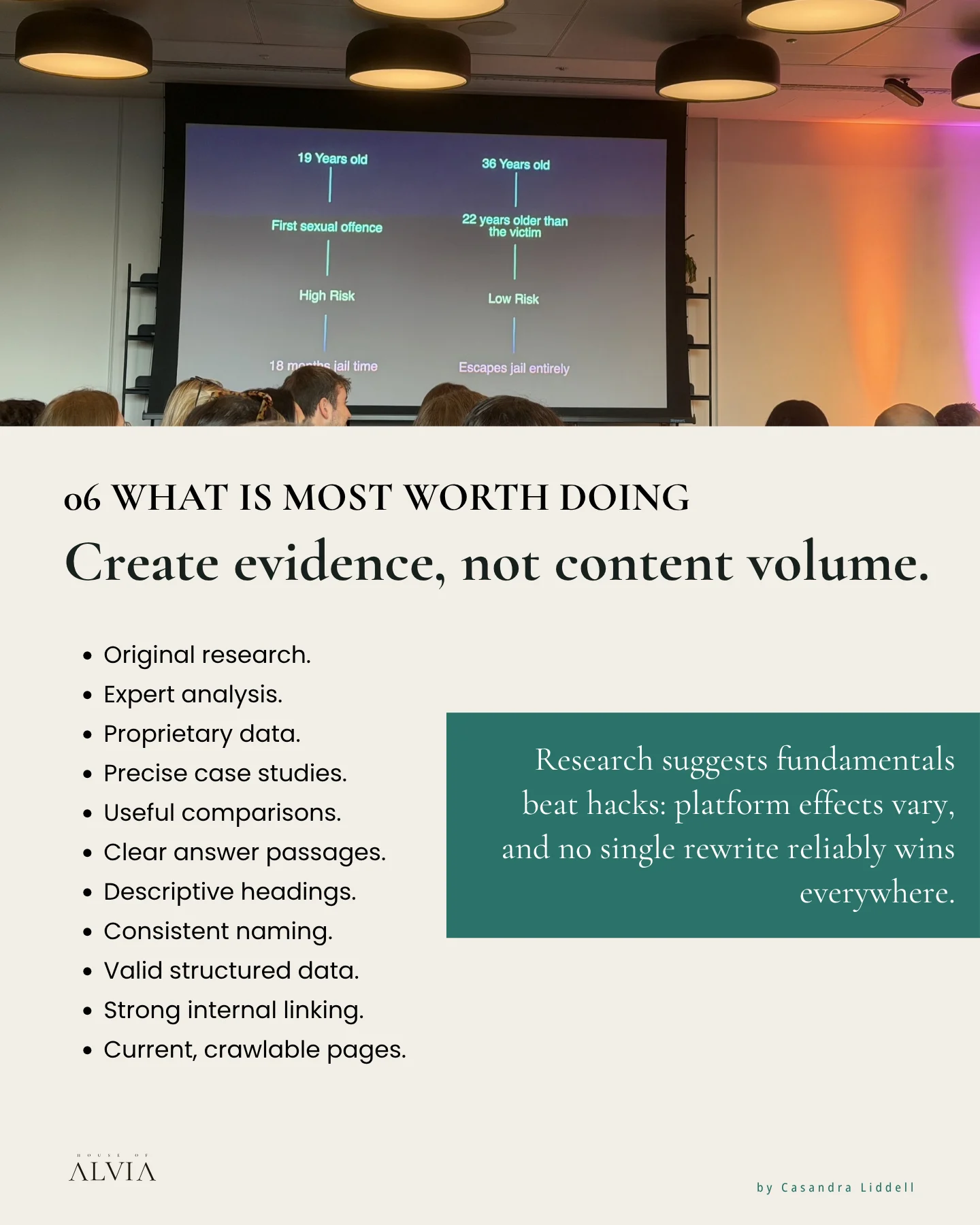
Create original information worth retrieving: first-party research, expert analysis, proprietary data, precise case studies, useful comparisons and genuinely new observations.
Write answerable passages. Put the core answer near the question it resolves. Use descriptive headings. Name entities consistently. Explain specialist language. Make important facts available as text, not trapped inside images.
Strengthen technical legibility. Ensure important pages can be crawled and indexed; maintain logical internal links; use valid structured data where it truthfully describes visible content; keep sitemaps and canonicalisation clean; and make updates discoverable.
Build corroboration beyond your own domain. Earned media, respected publishers, expert commentary, reviews, creators and relevant communities can become part of the evidence landscape around a brand. But this is not an invitation to manufacture consensus. Manipulated forums and synthetic praise create reputational risk and poor information quality.
Most importantly, give the system something specific to remember. Generic competence is difficult to cite. Distinctive evidence is easier.
Creators, communities and the new reputation layer
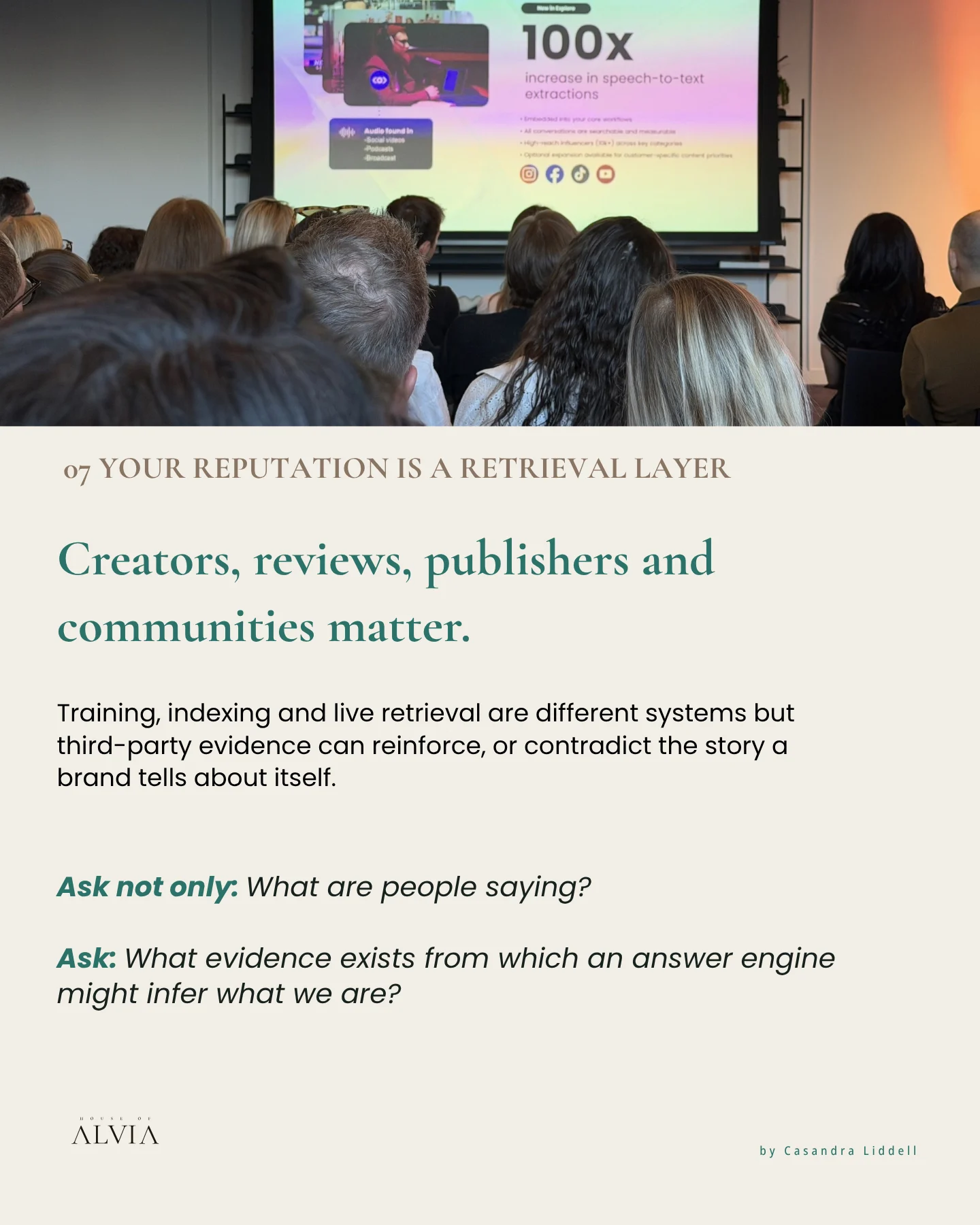
A line from the Summit stayed with me: creators are part of your AI footprint.
That does not mean every creator post is poured directly into every model. Training data, search indexes and live retrieval are different systems. But it does mean the public web around a brand matters.
If journalists describe a property as design-led, guests repeatedly praise the same service ritual, creators notice a particular detail and the brand itself articulates that attribute clearly, the narrative has reinforcement.
If the brand says “quiet luxury” while reviews say “formal”, creators say “Instagrammable” and press coverage focuses only on the celebrity opening, there is a narrative gap.
This is where PR, social listening and GEO begin to converge. The question is no longer simply “what are people saying?” It is “what evidence exists on the open web from which an answer engine might infer what we are?”
Sentiment analysis is not enough
Sentiment is useful, but blunt. Positive, neutral and negative classifications cannot tell you whether the market understands the attribute you most need to own.
I would combine sentiment with source and portrayal analysis.
For each priority prompt, record: whether the brand appears; which sources are cited; the position or prominence of the mention; the attributes associated with the brand; factual accuracy; sentiment or stance; competitor presence; and the action implied by the answer.
Then compare that with the intended narrative.
The most valuable gap may not be negative sentiment. It may be absence. If a brand wants to be known for exceptional private dining but AI answers consistently associate competitors with that occasion, the problem is not reputation in the conventional sense. It is missing evidence.
Measure a system, not a screenshot
Generative answers are stochastic. They change with model version, location, personalisation, wording, time and available sources. One prompt on one afternoon is not a strategy.
Build a repeatable benchmark instead.
Use a stable set of commercially meaningful prompts, then test controlled paraphrases across the principal surfaces relevant to your audience. Repeat the tests. Record dates and model/search settings. Separate branded prompts from category prompts. Compare against a fixed competitor set.
Measure the 4 Ps over time: Presence through answer and citation share; Prominence through relative visibility; Portrayal through accuracy, sentiment and association with must-win attributes; Persuasion through referral traffic, qualified visits, enquiries, conversions or other observable downstream behaviour.
Bing’s 2026 AI Performance reporting is notable because it formalises several of these ideas, including grounding queries, cited pages and citation share. Google has also introduced dedicated generative-AI visibility reporting in Search Console. Measurement is still imperfect, but it is becoming less anecdotal.
A practical 90-day approach
In the first 30 days, audit. Define the questions you need to win, the attributes you need to be known for and the competitors against which you are actually compared. Benchmark AI answers. Audit crawlability, indexation, entity consistency, important pages, third-party sources and narrative gaps.
By day 60, strengthen the evidence. Rewrite weak pages around real user questions without turning them into robotic FAQ farms. Publish missing proof: original data, expert viewpoints, comparisons, case studies and precise service or product information. Correct inconsistent profiles. Give PR and creator work a clearer set of evidence-rich narratives to amplify.
By day 90, measure and refine. Re-run the prompt set. Examine which pages and third parties are being cited. Track changes in portrayal and attribute association. Investigate where competitors still own the answer. Then repeat quarterly.
The goal is not to “game the LLM”. It is to make the brand easier to retrieve correctly.
The paradox: the more machine-readable the web becomes, the more human the advantage
There is an irony in all of this.
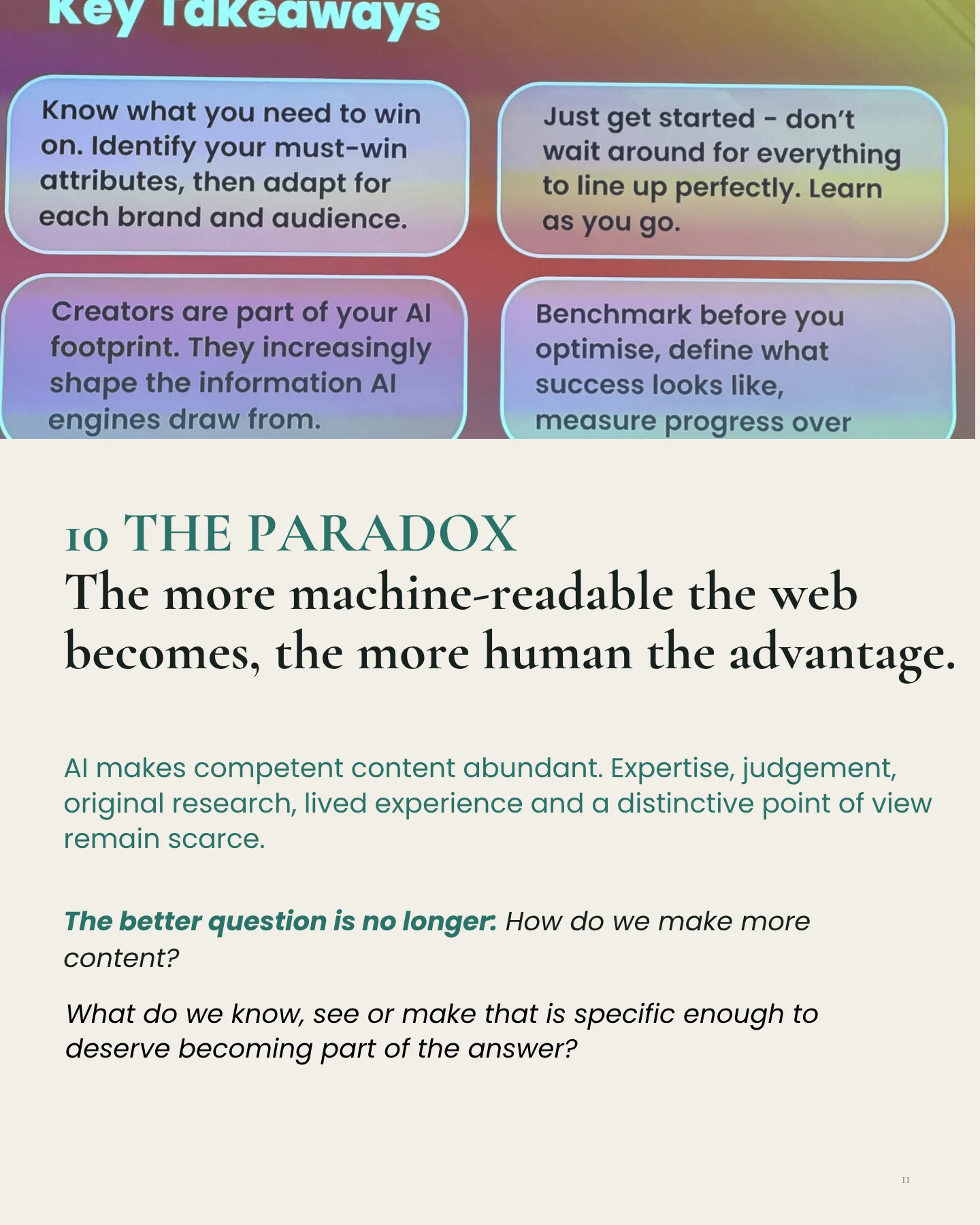
As AI makes competent content abundant, generic content becomes less valuable. The things that are hardest to manufacture at scale (expertise, judgement, original research, lived experience, a distinctive point of view, trusted relationships) become more important.
The web is moving from pages we search to answers assembled for us. That makes clarity essential. But it also makes originality more precious.
Perhaps the new optimisation question is not: how do we make more content?
It is: what do we know, see or make that is specific enough to deserve becoming part of the answer?
At House of ALVIA, that is the part I find most interesting. The future of visibility may be technical in its mechanics, but it is still profoundly human in what earns trust.
Selected sources & notes
- Google Search Central. Optimizing your website for generative AI features on Google Search (2026).
- Google Search Central. AI features and your website; people-first content and generative-AI content guidance.
- Microsoft Bing. AI Performance in Bing Webmaster Tools; AI Visibility Insights: Intents, Topics, Citation Share and Compare (2026).
- Microsoft Bing. Elevating the Role of Grounding on the AI Web (2026).
- OpenAI Help Center. Publishers and Developers FAQ: discovery, OAI-SearchBot and ChatGPT search.
- Anthropic. Web search documentation and crawler guidance.
- Perplexity Help Center. Pro Search: web retrieval, synthesis and citations.
- Aggarwal et al. “GEO: Generative Engine Optimization” (arXiv:2311.09735).
- Martinez. “Optimizing Visibility in Generative Engines: A Critical Survey of Generative Engine Optimization (2023 to 2026)” (arXiv:2607.14035).
- Meltwater Summit on Tour, London. Conference slides photographed by the author, including the 4 Ps of AI Visibility, GEO workflow, Sandals content blueprint and Meltwater GEO case-study slides. Vendor case-study claims should be treated as directional rather than independent causal proof.
Editorial note: GEO/AEO is a fast-moving field. Platform behaviour, models, reporting and crawler controls change frequently. Treat any optimisation claim as something to test longitudinally rather than as a permanent ranking rule.
Casandra LiddellHouse of ALVIA