
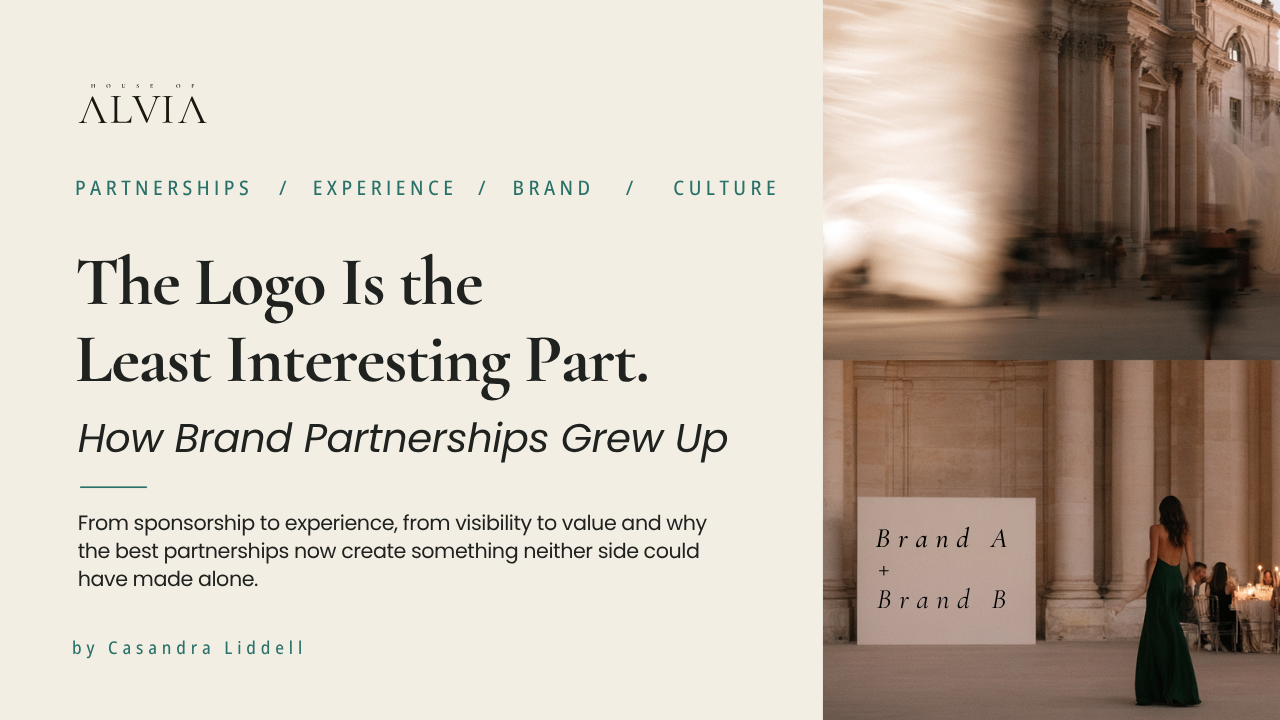
Partnerships · Experience · Brand · Culture
The Logo Is the Least Interesting Part.
How Brand Partnerships Grew Up
Perspective · September 2026
Words by Casandra Liddell
On partnerships, experiences and why the best collaborations no longer need to announce themselves quite so loudly.
There was a time when a partnership in marketing was wonderfully easy to identify. Two logos appeared next to one another, usually separated by a neat little line, somebody sponsored something, their name went on the wall, the invitation and, if budgets allowed, a rather optimistic quantity of branded merchandise. There was hospitality, there was signage, and there were inevitably photographs taken directly in front of that signage so that nobody could possibly miss the point. Everyone knew who had paid, which, for quite a long time, was the point.
Somewhere between sponsorship, collaboration, activation and what we now enthusiastically call the experience economy, however, something more interesting happened. The question began to shift from “Where does our logo go?” to “What can exist because we are here?” It sounds like a small change in language, but it represents a rather large change in marketing. Because the first question is about visibility. The second is about value. And, as it turns out, they are not quite the same thing.
From borrowing attention to creating value
Partnership itself is hardly new. Brands have been attaching themselves to sport, fashion, art, entertainment, hospitality and one another for decades, partly because association is one of marketing’s oldest and most useful tricks: stand beside something often enough and there is a reasonable chance that some of its meaning begins to rub off on you. Put yourself beside speed and perhaps you become more dynamic; beside craftsmanship and perhaps you acquire a little provenance; beside culture, rebellion, taste or prestige and the same mechanism applies. It is essentially social osmosis, except with rather more lawyers involved.
Marketing researchers have been studying these effects for decades through sponsorship, co-branding and brand alliances, and a 2021 systematic review covering 190 co-branding papers gives some sense of just how established the field has become. What is more interesting, though, is not simply that partnerships work, but that our understanding of what a partnership is supposed to do has changed.
Research examining more than 50 years of partnership literature describes a progression through three broad periods: transaction, formalisation and integrated systems. It is academic language, admittedly, but underneath it sits a very human progression. At first the relationship is essentially: I have something you want, and you have something I want. Then it becomes: We have complementary objectives, so perhaps we should work together. And eventually, at its most interesting: There is something neither of us could create quite as well alone.
That final stage is where partnership stops being adjacency and starts becoming addition. Or, to put it another way, two logos have finally found a reason to be standing next to each other.
The era of borrowed meaning
Traditional sponsorship was, in many respects, a property transaction. A brand acquired rights, and those rights bought some combination of visibility, association, access and hospitality, with the logo acting as a very useful receipt. There is nothing inherently wrong with that model. Visibility matters, distinctive assets matter, reach matters and repetition certainly matters. The problem comes when we assume that buying the right to be somewhere automatically gives us a reason for being there. Those are quite different things.
Recent analysis published by the UK’s IPA makes the distinction particularly well. Historically, sponsorship was often treated as a reach vehicle, effectively outdoor advertising with hospitality attached, whereas stronger contemporary programmes can stretch through broadcast, social, PR, retail, content and physical experience. In an analysis of 92 sponsorship effectiveness cases, 73% of the strongest-performing group reported sales effects and 54% reported business effects.
Source: IPA, sponsorship effectiveness analysis of 92 cases.
Sponsorship, in other words, did not disappear. It simply acquired rather more responsibilities. What was once a rectangle containing a logo gradually became an ecosystem around a relationship.
And then somebody “activated” it
Marketing has a charming habit of inventing extremely energetic words for perfectly human activities, and activation is one of my favourites because it makes the whole industry sound as though somebody has located a large red switch. Still, underneath the terminology sits an important evolution.
Academic sponsorship research distinguishes leveraging, meaning the marketing communications created around a sponsorship investment, from activation, which more specifically involves communications designed to encourage audiences to interact with the sponsor. That distinction matters because it fundamentally changes the role of the brand. A sponsor could simply be present. An activated sponsor had to contribute something people could actually encounter: access, participation, utility, entertainment, information, a different environment or perhaps simply a better version of the experience that was already taking place.
The logo said: We are associated with this. The activation said: This is different because we are associated with this. And the second is a considerably higher standard. It is also why the more interesting question in partnership marketing today is no longer simply how visible a brand will be, but what its presence makes possible.
A sponsor could simply be present. An activated sponsor had to contribute something people could actually encounter.
Events became experiences, or at least we started calling them that
Something similar happened to events. We still use the word, obviously, because an event remains a perfectly useful description of something happening at a particular time and place. But an event describes the container, while an experience describes what happens to the person inside it, and the distinction between the two has become increasingly important.
Pine and Gilmore’s work on the “experience economy” in the late 1990s helped formalise a shift from thinking exclusively about products and services towards thinking about the staging of memorable experiences. Later research explored experiences through dimensions including entertainment, education, aesthetics and escapism, finding that different combinations matter in different contexts.
The interesting implication is that memorability is not necessarily created by adding more. Another bar does not automatically make an experience. Neither does another DJ, another floral installation, another branded backdrop or another object positioned at precisely the correct angle for Instagram. Sometimes it merely creates a very busy event.
An experience is not event production with better lighting. It is the orchestration of how somebody feels, participates and remembers, including the parts they may never consciously notice but which quietly determine whether the whole thing feels effortless or oddly exhausting.
A dinner can therefore be an event, or it can create the conversation two people still remember three years later. A store opening can be an event, or it can alter someone’s understanding of the brand. A sponsorship can put your name inside a stadium, or it can give somebody access to something they simply could not have experienced without you. The ingredients can look remarkably similar on the production schedule. The intention is entirely different.
Memory is a rather different KPI from attendance
This is perhaps where experiential marketing has occasionally become a victim of its own success. Once the experience economy became fashionable, experience became one of those words marketing could attach to almost anything in the hope that it would become more interesting. Immersive experience. Curated experience. Elevated experience. Unforgettable experience. The last one is particularly ambitious when written before anybody has actually experienced it.
Because an experience is not really something a brand can declare. It is something another person has, and that tiny grammatical difference contains quite a useful strategic lesson. Research into experiential marketing increasingly treats it not simply as an event format but as the deliberate use of branded experiences to influence consumers, which moves the conversation away from what has been produced and towards what has actually happened to the person experiencing it.
There is also contemporary evidence for why physical encounters still matter in an overwhelmingly digital environment. Freeman’s 2025 research with The Harris Poll reported that 95% of surveyed working professionals said they trusted brands more after attending their live events, while 92% said live events positively affected their perception of brands. Vendor-commissioned research deserves the appropriate caveat, of course, but the direction is nevertheless interesting.
Source: Freeman with The Harris Poll, 2025.
As marketing becomes increasingly easy to produce digitally, perhaps presence becomes harder to fake. You can automate an email, generate fifty versions of an advertisement and create more content before lunch than a marketing department once produced in a month, but you cannot quite automate what it feels like to be welcomed into a room, to discover something unexpectedly or to realise that somebody thought about what you might need before you had to ask.
Perhaps that is why experience matters again. Not because digital stopped working, but because physical consideration became comparatively scarce.
Partnership is becoming the word of the hour
There is another shift happening alongside all of this: brands increasingly understand that they cannot manufacture cultural relevance entirely by themselves. Communities have their own language, creators have their own credibility, hospitality has its rituals, fashion has its codes, technology has capabilities, artists have perspectives and places have histories. A brand attempting to manufacture all of those things internally usually produces something that looks suspiciously like a brand attempting to manufacture all of those things internally.
Partnership offers a more interesting alternative: Don’t imitate what somebody else understands. Work with them.
Dentsu Creative’s 2025 CMO research, reported by WARC, found that 91% of surveyed CMOs agreed that brands today are built through partnerships between creators, platforms and culture makers, while 82% also worried about the loss of control involved. That second number may actually tell us more than the first. Because genuine partnership does involve losing a little control. If it doesn’t, you probably have a supplier.
Source: Dentsu Creative CMO research, 2025, reported by WARC.
A real partnership asks each participant to surrender something: authorship, certainty, visibility, sometimes even the comforting idea that your brand must always be the protagonist. That can feel uncomfortable, particularly for premium brands accustomed to controlling every millimetre of the frame, but it may also be precisely what gives the collaboration credibility. Research into horizontal marketing partnerships suggests that consumers judge not only whether two brands appear to fit, but whether the relationship itself feels authentic: real, genuine and credible. Compatibility, then, is no longer quite enough. The relationship needs a reason.
A small problem with the maths
I often think the simplest test of a partnership is mathematical. If 1 + 1 = 2, we have two brands standing beside one another, which is perfectly respectable but not especially interesting. A genuinely useful partnership should create a third thing: an idea, an audience, an experience, a product, a behaviour, a conversation or perhaps a piece of culture that neither participant would have produced independently.
So the more interesting equation is: 1 + 1 = 3. This is mathematically appalling, obviously, but strategically rather useful.
It does not mean collaboration is automatically magical. Most collaboration isn’t, and occasionally two perfectly good brands meet and produce something considerably less interesting than either of them managed alone. The point is that bringing two worlds together should create a third. Otherwise we are mostly rearranging logos.
Bringing two worlds together should create a third. Otherwise we are mostly rearranging logos.
The logo should be the signature, not the story
This becomes particularly interesting in premium and luxury, where communication has traditionally relied heavily on control: control the image, control the environment, control distribution, control the guest list and, whenever possible, control what everybody says about it afterwards. Partnership complicates that model because another point of view has entered the room.
But perhaps the more sophisticated brands have understood that control and discernment are not the same thing. Control is deciding everything yourself. Discernment is knowing whom to invite in, what to trust them with and why their presence will make the outcome better.
The strongest partnership therefore does not necessarily make both brands louder; it makes whatever they are creating richer. Sometimes one participant contributes access while another contributes expertise. One brings heritage and another a different audience. One provides a physical place while another gives that place a reason to matter. One provides technology so elegantly integrated that it almost disappears into the experience altogether.
That last possibility is particularly interesting because disappearance is something marketing has traditionally found rather frightening. We paid for this. Surely people should know. But perhaps one of the more sophisticated forms of activation is precisely the opposite: somebody benefits from what the brand has made possible before being reminded who made it possible. Recognition comes afterwards. The logo becomes the signature rather than the story.
Activation, not decoration
There is a distinction here that I think is worth keeping. Decoration puts the brand onto something; activation allows the brand to change something. A logo printed on a menu is decoration, whereas a collaboration that changes what can be eaten, who created it, where the ingredients came from or the conversation around the table begins to resemble activation. A logo beside an exhibition is sponsorship, while access to an artist, archive or perspective that fundamentally changes how somebody encounters that exhibition begins to look like partnership. A branded lounge is a space. A room designed around an unmet human need can become an experience.
The difference is not necessarily budget, although marketing departments have occasionally tried very hard to prove otherwise. The difference is thought.
Research into experiential sponsorship supports the idea that effective activations can combine rational or informational needs with sensory and individual experience. A case study examining Cisco’s London 2012 sponsorship, for example, found value in combining conventional B2B event principles with experiential design. That seems especially relevant now because the objective is no longer simply to interrupt an audience long enough to register a message. It is to improve the thing they already chose to enter.
Perhaps the next era isn’t collaboration at all
Partnership has become fashionable enough that it now risks suffering the fate of every useful marketing idea: being placed on a slide until it means almost nothing. Strategic partnership. Creative partnership. Culture partnership. Occasionally meaning little more than, we both quite like the look of each other’s audience.
The more useful question is not whether two names look compelling beside one another, but what each side contributes that the other genuinely cannot, followed by the slightly more uncomfortable question of what the audience receives that it could not receive from either one alone. Once you ask those questions, partnership stops being primarily a media strategy and starts becoming a form of value creation. The audience also stops being the target sitting conveniently at the end of the arrangement and becomes the reason the arrangement exists in the first place.
Perhaps that is the evolution hiding underneath all these words. Sponsorship gave brands presence, because being seen beside something valuable transferred some of its meaning. Activation introduced participation, because presence alone was no longer enough and audiences needed something to encounter. Experience shifted attention towards memory, because what happened to the person became more important than what had been produced around them. And partnership, at its best, creates possibility, because two different worlds can make something neither could quite have made alone.
It is not a tidy replacement of one model by another. Sponsorship still matters, logos still matter, events still matter and visibility certainly still matters. The interesting shift is that each has acquired a more demanding question. Not simply: Did they see us? But: Was it better because we were there?
That, I suspect, is the more useful measure of modern partnership. Not more logos, not necessarily more noise and certainly not another collaboration announced with the breathless confidence that two things have “come together” when we can quite clearly see that they have. Just a better reason for being in the room. And, occasionally, enough confidence to let people discover who made it possible afterwards.
Was it better because we were there?
Casandra LiddellHouse of ALVIA